

A legal publication editor opening a pitch about AI tools for lawyers already knows how the story usually goes. A list, ranked. A winner at the top. A table of prices that another list contradicts. A paragraph on ethics that says, in effect, check your citations. Most of those pitches die in the inbox, and the reason is rarely the topic. The topic is in demand. The reason is that the pitch gives the editor nothing she can check, nothing her readers cannot already find, and nothing that separates a firm’s own experience from a vendor’s brochure.
Coverage on this topic is earned differently. The firms and legal-tech vendors that get published are the ones that bring a checkable claim about one task, an honest account of a limit, and a verification step the reader can repeat. This article explains that standard from the editor’s side, maps the tools by the job they actually do, and sets out what to prepare before pitching. It does not rank tools, and it does not publish a price for any tool whose price could not be verified on the vendor’s own page on the day of writing — because on this topic, an unverified price is the fastest way to lose an editor’s trust.
The direct answer
There is no single best AI tool for lawyers. Research, contract drafting, discovery, practice management, and intake are different jobs, and the tools built for them are different products. A firm earns coverage by writing about one job well: naming the bottleneck, showing what the tool did with a real document type, stating what was checked before anyone relied on it, and saying plainly where the tool stopped being useful. A “best overall” list, by contrast, asks the editor to publish a ranking nobody can reproduce, built on prices that change by firm size, contract length, and jurisdiction. Editors who cover legal technology for a living recognise that list on sight.
The by-task map editors expect
Start with the work, not the vendor. A reader who searches for AI tools for lawyers usually has one painful task in mind, and a useful article meets her there.
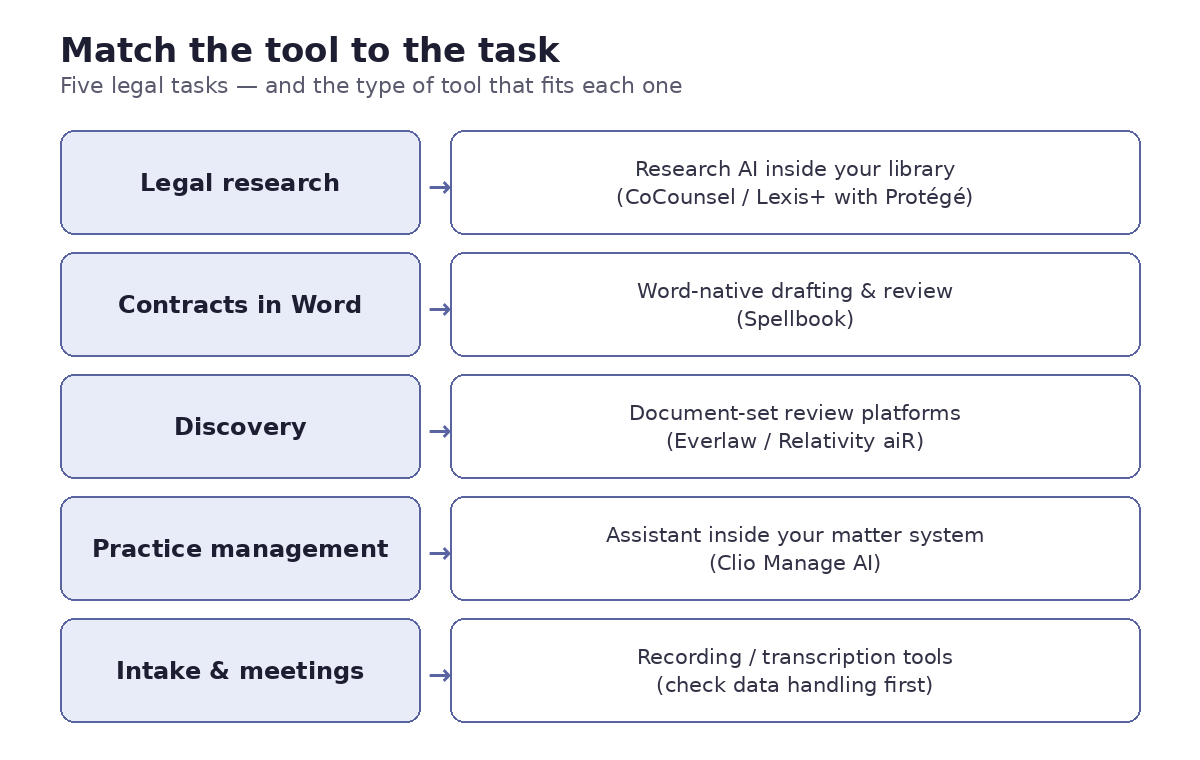
Legal research is the most consequential task, because a wrong answer can reach a filing. The established research platforms now carry their own AI layers: CoCounsel Legal, grounded in Thomson Reuters content including Westlaw and Practical Law, and Lexis+ with Protégé, grounded in LexisNexis content with Shepard’s citation validation. The practical point for a pitch is not which one is “better” in the abstract. It is which library the firm already pays for, because switching a research library to chase an AI feature is a different decision from switching on an AI layer inside the library the team already knows. A credible article says which library it tested, on what kind of question, and how each answer was traced back to the underlying authority.
Contract drafting and review lives, for most transactional lawyers, inside Microsoft Word. Spellbook is built for exactly that setting: review, drafting, clause suggestions, benchmarking against a playbook, and redlining as tracked changes, without leaving the document. Its pricing page, checked on 3 November 2026, publishes no per-seat figure — pricing is custom, structured around the number of team members on a licence, with a seven-day free trial. That is worth stating in a pitch, not hiding: a vendor that does not publish a price cannot be quoted a price by a third party, and any list that does so has invented the figure.
Discovery and document review is a volume problem. Platforms built for litigation and investigations analyse large document sets, surface responsive material, and help a team prepare a case from the documents themselves. A pitch in this area needs a scale the reader can picture — a matter type, a document type, a review step — rather than a claim about speed. Speed claims without a baseline, a document count, and a verification step read as marketing, and editors treat them that way.
Practice management is where small firms feel AI first, because the tool already holds their matters, documents, calendar, and billing. An AI assistant inside that system can summarise a matter or draft from its own documents. The coverage angle here is operational: what changed in the firm’s week, what the assistant was not allowed to do, and what a human still checked. A general claim that a firm “uses AI” says nothing. A specific workflow, with its boundary, says a great deal.
Intake and meetings — answering the phone, taking an intake call, summarising a consultation — is the half of legal work that happens out loud. Tools in this area record, transcribe, or answer, and the confidentiality question is immediate: what was recorded, where it went, and who could hear it. A pitch that does not address recording and data handling for this task will not survive an editor who covers legal ethics, however good the product story is.
Why this topic is hard to get published on
Three features of this topic make editors cautious, and a pitch that ignores them looks naive.
First, the prices disagree. For the same research platform, different lists publish figures that differ by hundreds of dollars a month, because the vendors themselves sell by segment, seat count, content bundle, and contract term. Thomson Reuters, for example, publishes starting figures for its in-house CoCounsel plans on its comparison page, while law-firm pricing is shown after firm details are entered or through sales. Neither figure is a universal price, and neither should be quoted as one. An article that acknowledges this — and says “get a written quote for your seat count and content” — is more useful, and more publishable, than a table that pretends otherwise.
Second, many lists are written by vendors. At least three of the prominent lists on this topic are published by companies whose own tool appears at or near the top. That does not make their product information false, but it does mean their ranking is not independent evidence. An editor will ask, reasonably, whether a pitch’s “best” claim comes from a test, a survey, or a sales page. If the answer is a sales page, the pitch needs a different claim — ideally, the firm’s own measured experience with one task.
Third, the ethics claims are usually flattened. “Verify citations” is true and insufficient. The American Bar Association’s Formal Opinion 512, issued on 29 July 2024, maps generative AI use onto existing duties: competence, confidentiality, communication, supervision, candour toward the tribunal, and reasonable fees, among others. It warns, in particular, about tools that learn from what users enter — a “self-learning” tool can surface one client’s information in another matter — and it treats boilerplate consent buried in an engagement letter as inadequate for that risk. A pitch that engages with that specific warning, and describes the firm’s own check on how a tool handles inputs, is writing for the editor’s actual readership. A pitch that repeats “verify citations” is writing for a search engine.
What editors look for: a checkable claim, a named task, a stated limit
A publishable legal-tech article usually contains three things, and a pitch should name all three before the editor has to ask.
The checkable claim is a statement the editor can verify without trusting the author. “We ran the tool on last quarter’s supplier agreements and it flagged the liability cap in 18 of 20” is checkable in principle; the editor can ask for the method. “It is the most accurate legal AI” is not. Numbers help only when the method travels with them: what documents, how many, what counted as a hit, and what a human found on re-check.
The named task keeps the article honest. A tool that drafts a first version of a non-disclosure agreement is not thereby a research database, and an article that keeps those jobs apart will not mislead a solo practitioner into treating a general chatbot as a citator. The by-task map above is the structure editors already use; a pitch that follows it is easier to place than one that invents a new taxonomy.
The stated limit is what separates an expert author from a vendor. Every tool on this topic has one: a research layer that still requires citation checks in the primary database, a contract tool that works only inside one word processor, a general model that must never receive identifiable client information on a free or personal account. Naming the limit in the pitch does not weaken it. It tells the editor the author has actually used the tool, or at least supervised someone who did, and it gives the article the tension that keeps a reader reading.
How a firm or vendor earns a placement
The route is unglamorous, and that is why it works. Pick the one task where the firm has the most specific experience. Write the article that task deserves, not the article the keyword deserves. Then pitch the publication whose readers do that task every day.
A litigation boutique with a discovery story should pitch a litigation publication, with the document type and the review step named, and the verification step described. A transactional practice that rebuilt its playbook inside Word should pitch a business-law or in-house audience, with the playbook decision — which clauses the firm would not let the tool change — at the centre. A legal-tech vendor should pitch the story its customers can corroborate: a named workflow, a named limit, and a customer willing to be quoted about both. In each case the article serves the publication’s readers first. The firm’s name travels because the article was useful, not because the article was about the firm.
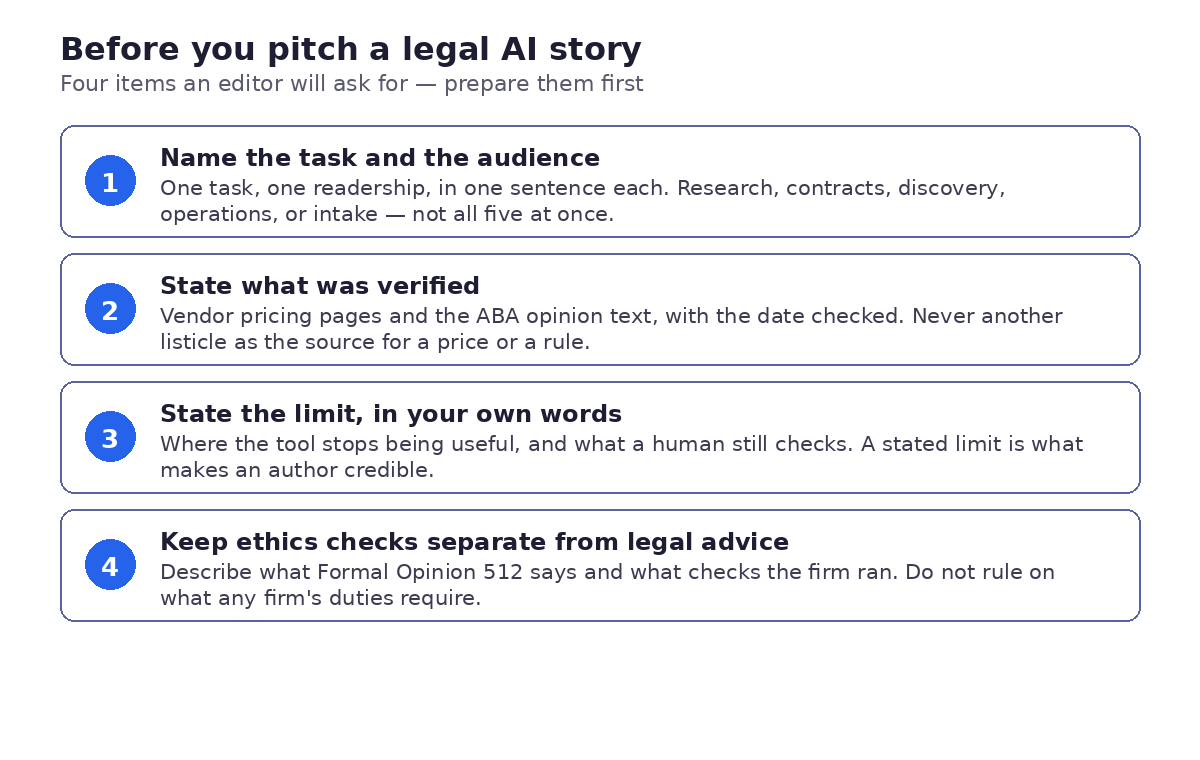
Before pitching, prepare four items. First, the task and the audience in one sentence each. Second, the verification record: what was checked, where, and on what date — vendor pricing pages and the ABA opinion text, not another listicle. Third, the limit, stated in the author’s own words. Fourth, the disclosure: who wrote the piece, whether the author sells or uses the tool described, and whether any placement is paid. A pitch that arrives with those four items answers the editor’s first four questions before she asks them, and that alone puts it ahead of most of the inbox.
Mistakes that get a pitch ignored
Copying a “best overall” list from another site, with its prices intact, is the commonest failure. The prices will be wrong for the editor’s readers, the ranking will be unreproducible, and the editor will have seen the same list before, under another byline.
Stating an ethics conclusion as if it were legal advice is the second. An outreach article can describe what Formal Opinion 512 says and what checks a firm ran; it cannot rule on what a particular firm’s duties require. That line matters to editors, and crossing it is a reason to decline a piece outright, not to edit it.
Presenting a vendor ranking as independent research is the third. If the author’s company sells the tool ranked first, say so in the pitch. Editors would rather publish a disclosed vendor perspective with a real workflow in it than an undisclosed one that reads like a review.
Finally, pitching a general AI chatbot as a legal research tool. General models are useful for first drafts, summaries, and plain-English explanations of supplied documents. They do not search a verified case-law database, and an article that blurs that line will mislead the exact reader — the solo or small-firm lawyer without a research subscription — who most needs the distinction drawn clearly.
Frequently asked questions
Which AI tool should a small law firm start with?
The one that fits the firm’s most painful task and, where relevant, the library or system it already pays for. A firm doing heavy research should trial the AI layer inside its existing research platform first. A firm drowning in contracts should trial the Word-native tool on its own paper, using the free trial period, before committing to a quote. A firm with neither pain point clearly identified should fix the workflow first; a tool bought to solve an unnamed problem will be measured against nothing.
How much do AI tools for lawyers cost?
It depends on seat count, content, jurisdiction, and contract length, and several of the main vendors do not publish a standard price. Spellbook publishes no per-seat figure and prices by team size, with a seven-day trial; research platforms generally quote after firm details or a demo. Treat any single figure in a list as unverified unless the list names the vendor page and the date it was read. Budget from a written quote for your own firm, not from a table.
Can a lawyer put client information into an AI tool?
Only after checking how the tool uses what is entered, and, for a tool that learns from inputs, after the client has given informed consent that actually describes the tool, the data, and the risk. Formal Opinion 512 treats boilerplate engagement-letter consent as inadequate for self-learning tools. The safe default, until those checks are done, is to keep identifiable client information out of general and free tools entirely, and to confirm the position with counsel or the relevant bar guidance. This article is not legal advice.
Do AI tools replace legal research databases?
No. The research AI layers are built on top of those databases — Westlaw content for CoCounsel, LexisNexis content and Shepard’s for Protégé — and their answers still need to be traced to the underlying authority and checked in the primary database before they are relied on or filed. A general chatbot is not a substitute for either.
The next step
Choose the task, in the order the firm feels it. Research first if filings depend on it. Contracts first if the inbox is full of third-party paper. Intake first if missed calls are lost clients. Write the one-task story with its check and its limit, pitch the publication whose readers do that task, and let the placement follow the usefulness of the piece. If the placement work itself — the publication list, the pitch, the follow-up — is more than the firm can run alongside client work, that is what a guest post placement plan covers, and the link building that follows a published article should grow out of coverage the reader actually valued, not out of a list the reader has already seen.

CEO & Founder at Meta LinkerSEO Strategist | Guest Posting Specialist | Digital Growth Consultant