
A new AI tool usually needs the same three things at once: first users, first links, and a description of the product that other sites can repeat accurately. A directory listing can help with all three, but only a little, and only when the directory is the right one. The rest of the work — the links that carry real editorial weight and the coverage that sends buyers, not just visits — still comes from placements on sites people already read.
So the direct answer is this: submit to a small number of relevant, indexed directories with complete profiles, check the fee and the link terms on each directory’s own page before you pay anything, and treat the listings as the foundation of a link plan. Then put the larger effort into guest posts and placements on publications in your niche. A long list of thin directory pages is not a strategy. It is a spreadsheet that looks like one.
How to judge a directory before you submit
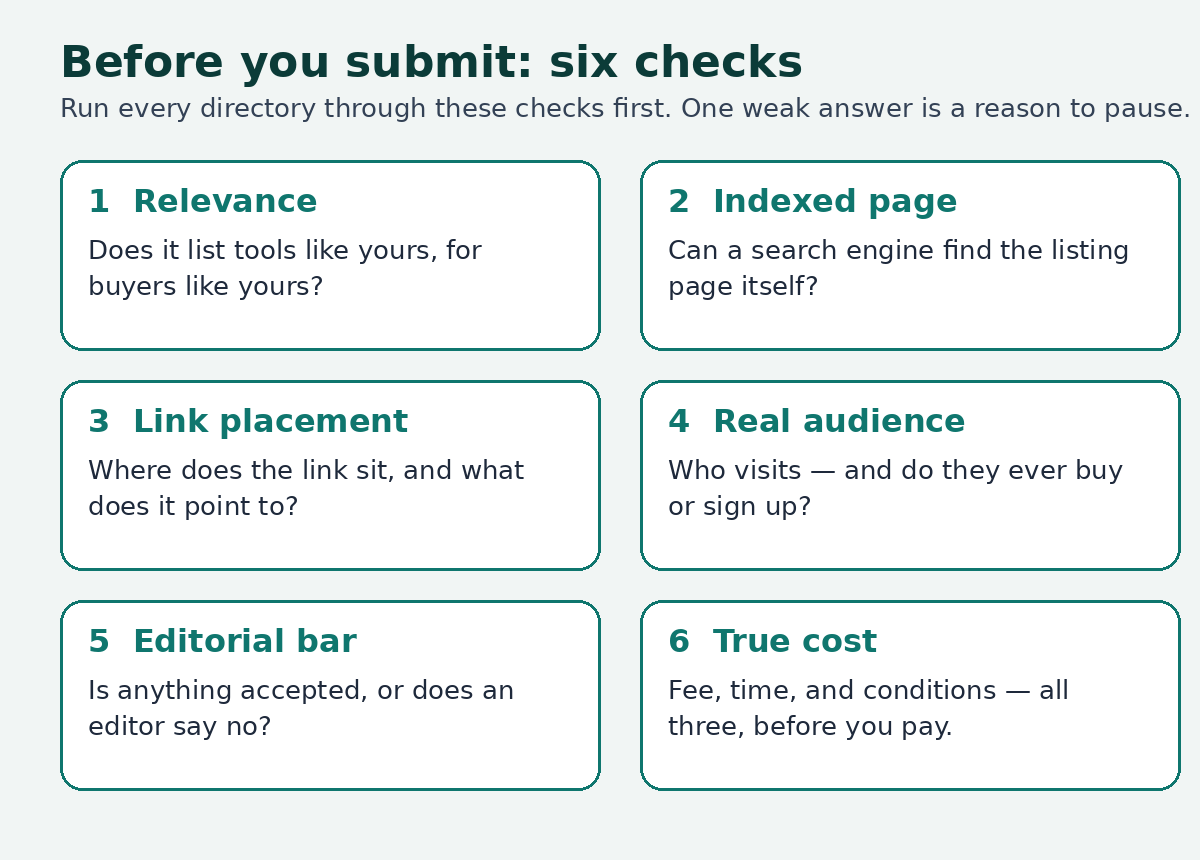
Most directory lists on the web disagree with each other. While researching this article on 2 November 2026, I found the same directories given different prices, different review times, and different link types in different guides — sometimes in guides published weeks apart. Authority scores differed too, sometimes sharply, for the same site. That is the first lesson: do not choose a directory from a listicle’s table. Open the directory, look at real listings in your category, and run the six checks below. If a directory will not let you see what a listing looks like before you pay, treat that as information.
Relevance. Does the directory list tools like yours, in categories a buyer would actually browse? A general startup list and an AI-only directory serve different readers. A writing tool listed among fifty unrelated SaaS products will be found by accident, if at all. A writing tool listed beside other writing tools will be found by comparison — which is also the harder test, because your description has to earn the click.
An indexed listing page. Search for a tool already listed there. Does its listing page appear in search results, with a title and description that make sense? A listing on a page no search engine has indexed cannot send search traffic, and it is a weak signal for anything else. This check takes two minutes and it settles more arguments than any authority score.
Link placement. Where does the link to your site sit, and what does it point to — your homepage, a pricing page, a sign-up page? Open a live listing and look. Some directories link only from a button. Some link from the listing body. The difference matters for the visitors who might click, quite apart from any search effect. And if you cannot tell from the live page whether the link passes ranking credit, do not assume it does. Check the page, or ask, and keep a note of what you found.
A real audience. Who visits, and what do they do there? A directory can be large and still send you the wrong people. Look at whether listings carry reviews, questions, or visible activity, and whether the directory’s own newsletter or social accounts show recent, relevant posts. A quiet directory is not automatically worthless — a small, focused one can still send the right ten visitors — but a directory that claims a huge audience should be able to show you where that audience is.
An editorial bar. Does anything get accepted? A directory that publishes everything, quickly, with no visible standards, is a weaker place to be listed. It also sits closer to the kind of low-quality directory Google names in its spam policies (see below). A directory with human review, clear acceptance criteria, and a refund when a tool is declined is telling you something useful about how it treats its own listings.
The true cost. The fee is only one part. Add the time to prepare assets, the wait for review, and any conditions attached to the price — a badge on your site, a newsletter slot you did not ask for, a credit that only applies if you launch there first. A “free” listing that needs a week of chasing is not free. A paid listing with a clear fee, a stated review time, and a refund on rejection can be the cheaper option, because you know what you bought.
Two directories, checked on their own pages
The two examples below are included because their own submission or launch pages could be read on 2 November 2026 and stated their terms in plain language. They are not a ranking, and they are not the only directories worth considering. They show what a verifiable listing looks like — and what to look for everywhere else. Re-check both before you act; terms change.
There’s An AI For That organises tools by the task they perform, so a visitor arrives with a job in mind rather than a brand name. On its launch page, checked 2 November 2026, a basic listing carried a $49 one-time review fee, described as a permanent listing, with an average processing time of 1–2 days, manual review by staff, and a full automatic refund if the tool is not published. The same page offered a $437 maximum-exposure package that adds a guaranteed newsletter feature — the newsletter subscriber figure on that page is the directory’s own claim, not an independent measurement — and a monthly thread on X where one tool is chosen for a free listing. The page also states that a $300 PPC bonus applies only when a tool launches on There’s An AI For That first. Two things the page did not state plainly in the text I read: the link attribute on live listings, and any authority score. I have not claimed either here. If the link type matters to your decision, open a live listing and check it before paying.
See the There’s An AI For That launch page.
Product Hunt is a launch platform rather than a standing directory, and that difference shapes what it is good for. Its launch guide, checked 2 November 2026, states that the platform is 100% free to use, that a maker submits through Submit and then New Product, and that 12:01 am Pacific Time is the suggested launch time for makers planning ahead. It also states the rules that catch first-time makers out: company accounts are prohibited, makers are encouraged to hunt their own products, and a launch link may be shared freely except that makers must not ask people directly to upvote. Homepage featuring is curated by Product Hunt’s team, so a launch is not a guaranteed homepage slot. What Product Hunt gives you, when a launch works, is a dated burst of attention and conversation — and a permanent product page that can keep working afterwards. What it does not give you is a quiet, standing listing you can submit and forget. Plan the day, be present for comments, and do not treat it as a backlink purchase. It is not one.
See the Product Hunt launch guide.
Directories to check before you pay
One other name appears in almost every guide to this topic, and it illustrates why a price copied from a guide is not evidence. Published guides from October 2026 disagreed with each other — and with older lists — about whether Futurepedia still offered a public submission form at all, what its last published fee was, and what link attribute its listings carried. I did not verify Futurepedia’s current submit page, price, review time, or link type on a primary source on 2 November 2026, so this article states none of them as fact and links to it not.
That is not a verdict on the site. It is a working rule worth adopting: if you are considering a directory whose terms you cannot confirm on its own submit page, on the day you would pay, do not budget for it yet. Open the submit page. Read the fee, the review time, and the refund terms. Look at a live listing. Take a screenshot of the terms before checkout. If there is no public submit page, ask how a listing is arranged and get the answer in writing. A directory that cannot answer those questions plainly is not a directory to pay first.
What to prepare before you submit
Directories reject, delay, or publish weak listings for the same handful of reasons, and almost all of them are fixed before submission, not after. Prepare one set of assets and adapt it to each directory’s character limits, rather than writing a fresh description in every form.
Start with the product name spelled exactly as it appears on your own site, and a one-sentence description that names who the tool helps and what it does. Write a longer description that explains what the tool does, who it is for, and how someone starts — without superlatives you cannot support. Take current screenshots that show the tool working, not a marketing mock-up of a screen that does not exist. Choose the closest category, not every category that might fit. State pricing honestly, including whether there is a free tier, and link to a page a stranger can actually try. If a directory asks for a video, use a short screen recording of the real product. A listing built from these assets reads like a product a real team maintains. A listing built from adjectives reads like an advert, and editors treat it like one.
How directories fit a wider link plan
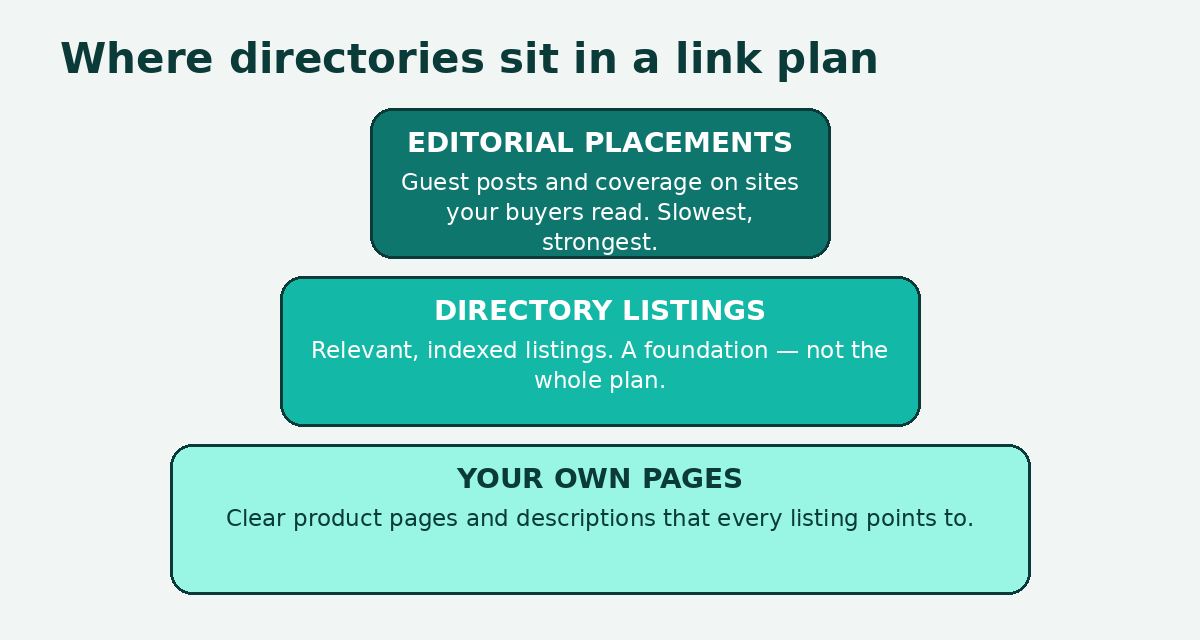
Think of the plan in three layers. At the base are your own pages: clear product, pricing, and use-case pages that every listing and every placement can point to. If those pages are vague, every link you build sends people somewhere that does not convert their curiosity into understanding.
The middle layer is directory listings: relevant, indexed, complete. They give a new tool a set of crawlable mentions, a consistent description in more than one place, and a trickle of discovery traffic. They are also the layer most founders over-invest in, because submitting feels like progress. Ten careful listings are a foundation. A hundred rushed ones are not ten times better. They are a hundred pages with the same thin description, on sites that may not be checked again.
The top layer is editorial: guest posts, expert commentary, and coverage on publications your buyers already read, with a link that exists because an editor thought the article earned it. That layer is slower and harder to arrange, which is exactly why it carries weight. It is also where a directory strategy ends and a link-building plan begins. If your tool’s story is worth a full article — a problem you solved, a workflow you measured, a mistake you can document — that story belongs on a publication, not only in a directory description.
One caution belongs in this section, because directory work sits close to it. Google’s spam policies, checked 2 November 2026, define link spam as creating links primarily to manipulate rankings, and list buying or selling links for ranking purposes, automated link creation, and low-quality directory or bookmark-site links as examples. Paid links are not themselves a violation when they are qualified with a rel=”nofollow” or rel=”sponsored” attribute. The practical reading for a founder is simple: submit to directories for discovery and for readers, keep the description honest, and do not buy bulk submissions or paid placements presented as editorial links. If a service offers you fifty directory links in a day, ask what those directories are, look at them, and walk away if you cannot.
Common mistakes that get a listing ignored or removed
The first is submitting before the product is usable. Directories and launch platforms review for a working tool; a waitlist page with no way to try anything will be declined, or published and ignored. Wait until a stranger can use the core function, even in a limited form.
The second is the same description everywhere, copied without regard to limits or audience. A description written for a developer directory will confuse a general audience, and a description written for everyone will convince no one. Adapt the assets; do not paste them.
The third is paying before reading. Fees, refund terms, badge requirements, and credit conditions live on the submit page, and they change. A screenshot taken before checkout is the cheapest insurance in this whole process.
The fourth is measuring nothing. Record the date, the directory, the listing URL, the cost, and the link as published. Without that record you cannot tell, a month later, which listings sent visitors and which ones merely exist. A listing that sent no one is not a failure on its own — some directories work slowly — but a set of listings you never review is money and time you cannot account for.
The fifth is treating a directory listing as a substitute for a publication placement. Listings rarely send the volume or the quality of reader that a good guest post does, and they rarely earn the kind of link an editor gives because the work was worth citing. Use both, for different jobs, and judge each by what it actually delivered.
Frequently asked questions
Do directory links help a new site rank?
Sometimes, modestly, and never on their own. A relevant, indexed listing can help a new tool be discovered and crawled, and it adds a consistent mention of the product in more than one place. It does not replace editorial links, useful content on your own site, or a product people return to. No directory can promise a ranking, and any service that does is selling something else.
Should I pay for a directory listing?
Pay only when three things are true: the directory is relevant and indexed, its own submit page states the fee, review time, and refund terms plainly, and the audience it reaches matches your buyers. The $49 fee checked on There’s An AI For That’s launch page on 2 November 2026 met that test on paper; a fee on a directory whose terms you cannot read does not. Start with the free and low-cost listings that pass the six checks, and pay first where the audience is clearest.
How many directories should I submit to?
Fewer than most guides suggest. A realistic first pass is ten to twenty relevant directories with complete profiles, submitted in order of fit, then reviewed after a few weeks. The right number depends on how many directories genuinely match your tool. Submitting to directories that do not match it adds pages, not progress.
When is a guest post the better move than a directory listing?
When you have something to say that needs more than a description: a workflow, a comparison you can defend, a problem your tool solved in a way readers can copy. A guest post on a publication your buyers read can send the right visitors, earn an editorial link, and give you an asset to share for months. A directory listing cannot do that job, however well it is written. If you have one strong story and limited time, spend the time on the story.
What to do next
Submit in this order: first, the directories that pass all six checks and state their terms plainly. Then the launch platform, planned as a launch day rather than a form to fill in. Then, while listings are under review, the editorial work — one strong guest-post pitch to a publication your buyers read, built around a problem you can document rather than a product you want to mention. Keep the record of every listing, check it again in a few weeks, and keep what sent real visitors.
If that editorial layer is the part you do not have time to run — finding the publications, pitching the angle, placing the article, and checking that the link stays live — that is the work guest post placement and link building cover. Start with the listings you can verify today. The placements are what turn a set of listings into a link profile that actually moves.

CEO & Founder at Meta LinkerSEO Strategist | Guest Posting Specialist | Digital Growth Consultant