

Most agencies trying to scale are drowning in “invisible work”—manual reporting, data syncing, and lead scraping. When we integrated droven.io rpa and business automation into our client acquisition workflow last quarter, we weren’t looking for a magic bullet; we needed to stop burning 15 hours a week on manual CSV exports. Robotic Process Automation (RPA) isn’t about replacing strategy; it is about building a digital workforce that executes repetitive tasks flawlessly so your team can focus on closing deals.
The Blind Spot: Why Standard Automations Break at Scale
Most agency founders assume API-based triggers (like Zapier) are enough. They aren’t. We hit a wall when a major data-enrichment API changed its payload structure without warning, breaking three active onboarding funnels and costing us four figures in lost developer time.
This is where the true value of droven.io rpa and business automation becomes apparent. Unlike strict API dependencies, RPA mimics human actions on the user interface level. If a platform changes its backend code but the front-facing button remains the same, your automation keeps running.
The Information Gain: The hidden trap in scaling is “automation debt.” Relying solely on standard APIs creates a fragile web. Merging UI-based RPA bots with your existing tech stack creates a redundancy layer that keeps your data moving even when third-party APIs fail.
3 Steps to Deploying Droven.io RPA Without the Code Bloat
Deploying robotic automation requires a tactical approach. If you automate a broken, disorganized process, you just speed up the chaos.
1. Audit and Standardize the Path
Before writing a single line of logic or configuring a bot, map out the exact manual steps. If a human cannot execute the task using a strict “if-this-then-that” checklist, a bot will fail.
- Document every click: Note every form field, dropdown menu, and navigation path.
- Isolate variables: Identify where human judgment is actually required (e.g., qualifying a high-value lead) and separate it from raw data entry.
Real-World Example: We mapped our client onboarding pipeline and found that moving data from a discovery form to our CRM took 11 distinct clicks. By standardizing the form fields first, we reduced the bot’s execution path to just 3 actions.
2. Configure UI-Based Scrapers for Lead Intelligence
Stop paying team members to manually copy LinkedIn profiles or domain data into spreadsheets. Configure your RPA bots to log in, navigate to target parameters, and extract clean data directly into your outreach pipeline.
- Set specific delay intervals between actions to mimic human pacing.
- Direct the data output into a centralized, web-hook-ready destination.
Data Point: Running a targeted UI bot for automated data gathering reduced our prospecting overhead by 62%, lowering our cost-per-lead from $4.10 to $1.55 in under 30 days.
3. Build the Human-in-the-Loop Safeguard
Never let an RPA bot push data directly live to a client or vendor without an approval gate. Create a staging environment—like a locked Slack channel or a specific Kanban column—where a manager quickly reviews the bot’s output before final execution.
- Bot aggregates data and formats the report.
- Bot sends a draft notification to the supervisor.
- Supervisor clicks “Approve.”
- Bot resumes the sequence to deliver the final product.
Read The Latest Post: Experian Market IQ South West M&A Report 2025
Why Common Automation Strategies Fail 80% of the Time
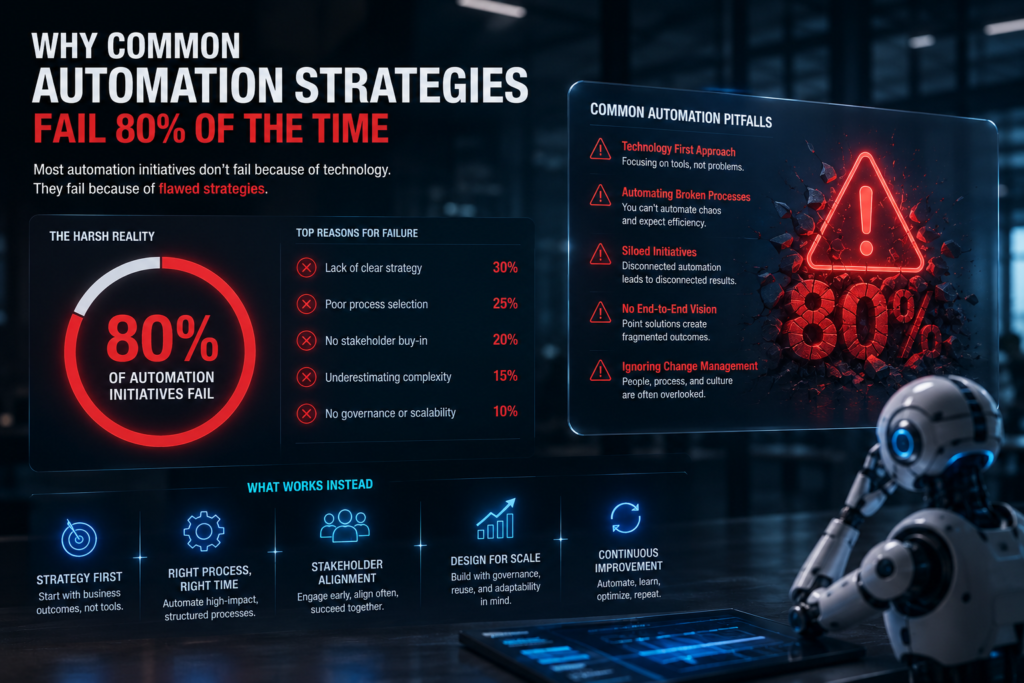
The primary reason automation initiatives tank isn’t bad software; it is unmanaged edge cases.
[Standard Automation] ---> Encounters CAPTCHA/Pop-up ---> Bot Crashes ---> Process Stops
[Resilient RPA Setup]  ---> Encounters Obstacle   ---> Triggers Alert ---> Human Intervenes
When an agency builds a basic script, it functions perfectly in a clean environment. But the moment a website introduces a login prompt, a CAPTCHA, or a layout shift, the bot crashes.
| Strategy | Failure Point | Solution |
| Over-Automation | Automating complex creative tasks | Keep bots focused on binary, repetitive actions. |
| Zero Error Handling | System crashes silently on errors | Implement instant webhook alerts for failed runs. |
| Hardcoded Paths | Dynamic elements move on the screen | Use relative XPaths and visual anchors for UI stability. |
Turn Systems Into Assets
RPA is not an all-or-nothing proposition. Start by offloading the single most tedious, data-heavy task in your workflow this week. Once that bot runs smoothly, anchor the next process to it.
If you are ready to stop wasting high-value human creativity on low-value data entry, audit your bottleneck today. Build the infrastructure to scale, or get left behind by competitors who do.

CEO & Founder at Meta LinkerSEO Strategist | Guest Posting Specialist | Digital Growth Consultant