

A credit risk editor has a problem most other editors do not. Her readers will act on the article — approve a loan, price it, or decline it — and a regulator may later ask how the model behind that decision was built, validated, and explained. So when a pitch arrives claiming a new technique “beats” every older one, she does not ask first whether the claim is exciting. She asks whether it can be checked, whether the limit is stated, and whether the governance cited is still current. Most pitches fail at least one of those three tests, and the failure is usually visible in the first paragraph.
This article is written from that editor’s side of the desk. It maps the techniques a pitch is likely to name, explains what each one actually does and where it breaks, and sets out the governance correction that separates a current pitch from an out-of-date one. It is about coverage, not about choosing a model for a lender — though, as with finance topics generally, the discipline that makes a story publishable is close to the discipline that makes a model defensible.
The direct answer: the publishable story is a checkable method, not a winning model
There is no single winning technique in credit risk modeling, and a pitch that names one should be treated with suspicion. Different techniques win on different datasets, for different loan types, under different validation rules — and the published literature itself shows that disagreement, with different studies on different data reaching different winners. A story that hides that disagreement behind one accuracy figure is not simplifying. It is misleading, and an editor in a regulated field knows it.
What editors publish instead is a method they can follow: one technique, applied to one decision, validated on data the model did not train on, with an explanation route for the applicant who is declined and a fairness check run before deployment. Lead with that, and the pitch reads as reporting. Lead with a percentage and no dataset, and it reads as marketing.
To follow the rest of this article, three quantities matter. Probability of default, or PD, is the likelihood that a borrower defaults over a given horizon. Loss given default, or LGD, is how much the lender loses if default happens. Exposure at default, or EAD, is how much is outstanding at that point. Expected loss is the product of the three: PD × LGD × EAD. Most of the techniques below are, at heart, ways of estimating PD — and sometimes LGD and EAD — from borrower and loan data. Keep that in mind whenever a pitch talks about “risk” without saying which of the three it means.
The technique map: five families, five different trade-offs
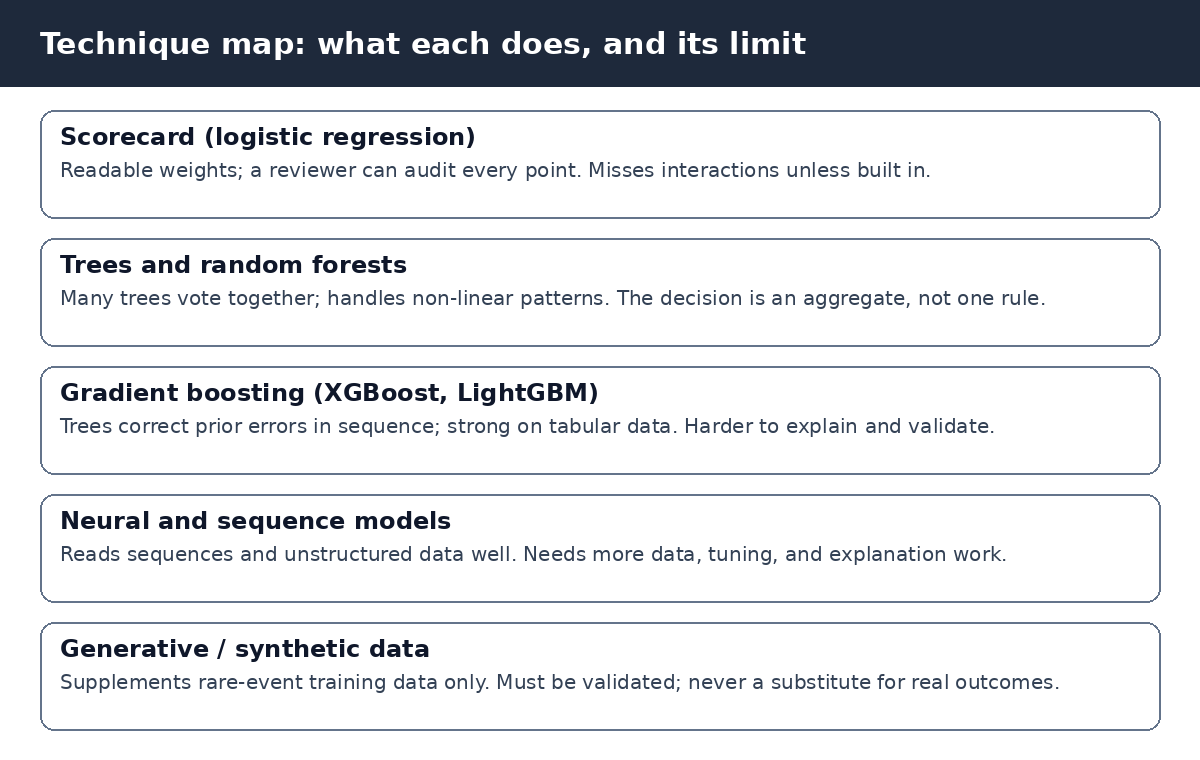
The scorecard baseline: logistic regression. The traditional credit scorecard is usually a logistic regression model: it estimates the probability of default from a weighted combination of inputs, and each weight can be read and argued about. Analysts have historically grouped variables into bands and converted them into points, so the final score is a sum a human can audit. That auditability is the point. Logistic regression remains the benchmark every new model is compared against, not because it is the most powerful technique, but because it is the one whose reasoning a reviewer, a validator, and an applicant’s reason code can all follow. Its limit is also plain: it assumes a particular shape for the relationship between inputs and risk, and it will miss interactions — say, a combination of high utilisation and recent inquiries that is riskier than either factor alone — unless the analyst builds those interactions in by hand.
Decision trees and random forests. A decision tree splits borrowers again and again on the variable that best separates good from bad at each step, until it reaches a leaf with a risk estimate. One tree is easy to draw and easy to overfit: it can memorise the training data’s quirks. A random forest grows many trees on different subsets of data and variables and averages their votes, which tames that overfitting and handles non-linear patterns without hand-built interactions. The cost is partial opacity. You can inspect any single tree, but the forest’s decision is an aggregate, and explaining one applicant’s outcome means explaining the aggregate, not one tidy rule.
Gradient boosting: XGBoost and LightGBM. Gradient boosting also builds many trees, but in sequence rather than in parallel: each new tree corrects the errors of the trees before it. XGBoost and LightGBM are two widely used open-source libraries for this method, and on tabular credit data — rows of borrower and loan attributes — they are the usual workhorse. LightGBM’s leaf-wise growth and histogram binning, for example, are engineering choices that make it fast on large datasets. The trade-off is governance cost. A boosted ensemble is harder to explain than a scorecard, harder to validate, and easier to overfit if its tuning is left unchecked. A pitch that names gradient boosting without naming its validation and explanation route has named only half a model.
Neural networks and sequence models. Neural networks stack layers of connected units to learn complex patterns, and they earn their place where the data is sequential or unstructured: months of account activity read as a sequence, or text from documents. A sequence model can notice a steadily shrinking balance in a way a static snapshot cannot. For standard tabular credit data, however, tree-based models often match them, and neural networks demand more data, more tuning, and more explanation effort. Their pitch risk is the opposite of the scorecard’s: the model may be genuinely powerful and genuinely unexplainable in the form a declined applicant needs.
Generative and synthetic data: a limited tool, not a technique. Generative models — the family behind synthetic data generation — are sometimes pitched as a credit risk technique in their own right. In a credit story they belong in a narrower place: generating synthetic examples of rare events, such as defaults in a thin portfolio, to supplement training data, or helping a team think through a scenario it has rarely observed. Synthetic data does not remove the validation problem. It moves it: the team must now show the synthetic data resembles the real population closely enough, and does not leak real borrowers’ information or bake in the biases of the data it was trained on. A pitch that treats synthetic data as a substitute for real outcomes, rather than a supplement to be validated, will not survive a careful editor.
Why this topic is hard to get published on
Four habits kill credit risk pitches, and all four are visible in the current search results for this keyword.
First, an accuracy figure without a dataset. A percentage lifted from one study, on one portfolio, in one country, presented as a property of the technique itself. The editor’s question is immediate: accuracy on what, against what baseline, on data the model had never seen? If the pitch cannot answer, the figure is decoration, and in a regulated topic decoration is a liability.
Second, outdated governance cited as current. Much of the older content on this topic cites SR 11-7, the 2011 US supervisory guidance on model risk management, as if it were still the framework. It is not. In April 2026 the Federal Reserve, the OCC, and the FDIC issued revised interagency guidance — Federal Reserve SR 26-2, OCC Bulletin 2026-13 — that supersedes and replaces SR 11-7. A pitch that still anchors itself to SR 11-7 without mentioning the replacement tells the editor the author has not checked the framework since 2011. That single error can sink an otherwise good pitch, because it raises the question of what else was not checked.
Third, a “black box” offered without an explanation route. A lender that declines an applicant must be able to give specific reasons, and the model cannot be an excuse for failing to do so. Regulation B, which implements the Equal Credit Opportunity Act, requires a statement of specific reasons indicating the principal reason or reasons for adverse action, and it states plainly that internal standards or a failed qualifying score are not sufficient. A pitch for a complex model that never mentions how a denial will be explained is a pitch for a product that cannot be shipped in consumer credit as described. Editors know this, even when vendors seem not to.
Fourth, fairness treated as an afterthought. A model that never uses a protected characteristic as an input can still produce different outcomes for different groups through proxies — variables correlated with protected characteristics. Fairness testing, run during development rather than after deployment, is how a team finds that out. A pitch that mentions fairness only in the final paragraph, with no test named, reads as a disclaimer rather than a design choice.
The same by-task discipline applied to finance AI tools generally is set out in the companion piece on AI tools for finance teams.
The 2026 governance correction, stated plainly
Because so much existing content is out of date, the correction deserves its own section rather than a footnote. The revised guidance, SR 26-2 and OCC Bulletin 2026-13, both dated 17 April 2026, restate model risk management as a principles-based, risk-based approach, tailored to a banking organization’s model risk profile and the size and complexity of its operations. The primary sources state three limits a pitch must respect.
First, scope: the guidance is expected to be most relevant to banking organizations with over $30 billion in total assets. It is not a universal rule for every lender, fintech, or vendor, and a pitch should not present it as one. Smaller institutions may still adopt its principles, but that is adoption, not applicability, and the distinction matters to an editor.
Second, generative and agentic AI models are explicitly not within the scope of the guidance, because the agencies describe them as novel and rapidly evolving. The agencies say they plan a request for information on model risk management and banks’ use of AI, including generative and agentic AI. So a pitch that claims a generative credit model is “SR 26-2 compliant” is claiming something the guidance itself does not cover. The honest phrasing is that the model sits outside that guidance’s scope and must be governed under the organization’s broader risk practices — a harder sentence to write, and a more credible one.
Third, the guidance does not set forth enforceable standards or prescriptive requirements, and the OCC bulletin states that non-compliance will not result in supervisory criticism. That does not mean model risk management is optional. It means the guidance is a statement of sound principles, not a checklist, and a pitch that treats it as a certification to be passed has misunderstood what it is. The same bulletin discusses model development and use, validation and monitoring, governance and controls, and vendor and third-party products — the areas a serious pitch should address in its own words, not by invoking the guidance’s name.
One further point, for accuracy: the OCC bulletin also rescinds the old credit scoring examination guidance, OCC Bulletin 1997-24. A pitch citing that 1997 bulletin as live examination guidance is making the same class of error as one citing SR 11-7 as current. Check the date, every time.
How a credit-risk vendor earns a placement
The strongest credit risk stories share a shape, and it is worth building deliberately. Start with one real workflow, told in order: where the application arrives, what data is used, which technique estimates the risk, how the score becomes a decision, what happens to the borderline cases, and how a declined applicant is told why. A workflow told in order is hard to fake and easy for a reader to test against their own process.
Then attach the validation evidence, in the terms a validator would use: discrimination (does the model rank good borrowers above bad ones?), calibration (do the predicted probabilities match the default rates actually observed?), and out-of-time testing (does it hold up on a later period than the one it was built on?). A model validated only on the data it trained on has not been validated at all, and an editor who knows the field will ask that question first.
Then name the explanation route. Post-hoc methods such as SHAP (SHapley Additive exPlanations) and LIME (Local Interpretable Model-agnostic Explanations) estimate each feature’s contribution to one decision, and they are the usual route for explaining a complex model’s output. But an explanation is not automatically a valid reason code: it must reflect the factors actually scored, and it must be checked for consistency. A pitch that says “we use SHAP” without saying how the resulting reasons were validated against the model’s actual decision has offered a tool, not an answer.
Then name the fairness test, run during development: which groups were compared, on what outcome, and what happened when a disparity appeared. The pitch does not need to publish the full test results to be credible, but it does need to show the test exists and that it can change the decision — for example, by sending a model back for rework. A fairness section that cannot change anything is decoration.
Finally, offer the editor something she cannot get from the vendor’s own blog: a failure case, a limit, or a decision the team made and why. A vendor explaining why its model is the wrong choice for a thin-file portfolio, or why it stayed with logistic regression for one product despite a more powerful alternative, is memorable precisely because it is rare. That honesty is what earns the backlink and the second placement.
What to prepare before pitching a credit publication
Before a single email goes out, assemble a small pack. First, the topic in one sentence, naming the technique and the reader: “How gradient boosting changed the validation workload for a mid-size lender’s unsecured portfolio, and what its validators required before sign-off.” If the sentence needs a second clause to make sense, the topic is still two topics. Split it.
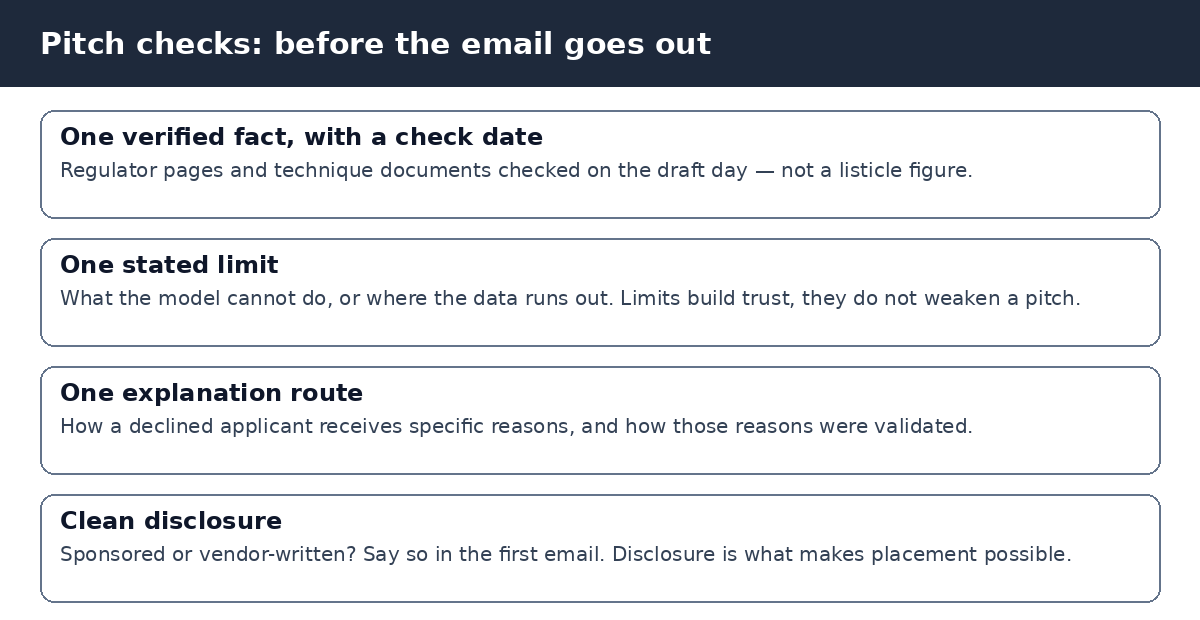
Second, the verified facts, each with its source and check date: the SR 26-2 replacement, the Regulation B specific-reasons requirement, the technique descriptions as documented. Keep this list short. Three verified facts beat ten unverified ones, and the editor will check at least one.
Third, the example or workflow, told in order, with the limit included. If the example is a customer’s, have the permission in writing before the pitch. If it is your own team’s, say so. Never present a hypothetical example as a real one.
Fourth, the disclosure. If the article is sponsored, placed, or written by a vendor about its own product, say so in the pitch. Editors decide placement partly on disclosure, and discovering a commercial relationship after acceptance ends the relationship. A clean disclosure in the first email builds the trust that gets the second article accepted.
Fifth, the format the publication actually runs. Read three recent articles in the target publication and match their shape: length, headings, whether they run tables, whether they link out to regulator pages, how they handle author bios. A pitch that fits the publication’s shape gets read. A pitch that asks the editor to invent a new format for you does not.
Mistakes that get a pitch ignored
A copied technique list is the fastest route to the archive folder. If the pitch could have been written by reading three other lists, the editor has already read those lists. Originality here does not mean a contrarian opinion. It means a specific decision, a validation result, and a limit — the three things lists omit.
An accuracy figure without a dataset is the second mistake, and the most common in this market. One study’s number, presented as a property of the technique, tells the editor the author did not read the study’s method section. In credit, where the reader will act on the number, that is not a style issue. It is a credibility issue.
An outdated guidance citation is the third, and newly common since April 2026. SR 11-7 cited as current, or the 1997 credit scoring bulletin cited as live, each tell the editor the author’s research stopped years ago. In a topic where the framework changed this year, that error is disqualifying on its own.
A pitch with no explanation route is the fourth. A complex model offered for consumer credit decisions, with no account of how a declined applicant will be given specific reasons, is a pitch for a product that cannot be used as described. Name the route, and how it was validated, or do not pitch that model for that use.
And a pitch that hides the commercial relationship is the fifth, and the most damaging long-term. One undisclosed placement can close a publication permanently. Disclosure is not a penalty. It is the condition that makes the placement possible.
FAQs
Which AI technique is best for credit risk modeling?
There is no single best technique. Logistic regression is the interpretable baseline, gradient boosting is the common workhorse on tabular data, and neural networks fit sequential or unstructured data — but the right choice depends on the data available, the decision’s stakes, the explanation the applicant must receive, and the validation capacity of the team. Different studies on different datasets reach different winners, which is why the choice must be validated on the lender’s own data, not copied from a list.
What is the difference between PD, LGD, and EAD?
PD is the probability that a borrower defaults over a given horizon. LGD is the share lost if default happens. EAD is the amount outstanding at default. Expected loss is PD × LGD × EAD. Most credit models estimate PD first; LGD and EAD need their own models and data, and a pitch that talks about “risk” without saying which of the three it means is hiding the hard part.
How is a credit risk model validated?
By testing it on data it did not train on, and on a later period than the development data, and by checking both discrimination (ranking good above bad) and calibration (predicted probabilities matching observed default rates). Validation also covers stability over time and ongoing monitoring after deployment. A model tested only on its training data has not been validated.
Can a lender use a model it cannot explain?
Not for a consumer credit decision that requires an adverse-action notice. Regulation B requires a statement of specific reasons indicating the principal reason or reasons, and internal standards or a failed qualifying score are not sufficient. Post-hoc explanations such as SHAP and LIME are a route to those reasons, but the reasons must reflect the factors actually scored and must be validated — an explanation layer that disagrees with the model is a compliance gap, not a solution.
What changed in US model risk guidance in 2026?
In April 2026, the Federal Reserve, OCC, and FDIC issued revised interagency guidance — SR 26-2 and OCC Bulletin 2026-13 — that supersedes and replaces SR 11-7 from 2011. It is principles-based and risk-based, most relevant to banking organizations over $30 billion in assets, does not set enforceable standards, and explicitly excludes generative and agentic AI models from its scope. Older articles citing SR 11-7 as current are out of date.
Is this article financial or legal advice?
No. It is general information about earning editorial coverage on a regulated topic. Decisions about models, validation, fairness testing, or adverse-action notices should be made with the lender’s own risk, legal, and compliance teams.
What to do next
Build the pitch in this order: one technique, one decision, one validation result, one explanation route, one stated limit, and governance cited as it stands in 2026, not as it stood in 2011. If the story survives those six checks, it is worth pitching. If it does not, fix the story before pitching it — an editor will find the gap faster than a reader will, and a rejected pitch costs more than a delayed one.
If the bottleneck turns out to be visibility — the story exists, but the right editors and readers are not finding it — that is a different job, and it is the one Meta Linker does: guest post placement and link building that put a checkable story in front of the publication that should run it. The same discipline applies in both places. Say what you can verify, name the limit, and let the editor check.

CEO & Founder at Meta LinkerSEO Strategist | Guest Posting Specialist | Digital Growth Consultant