

A finance editor opening a pitch about the best AI tools for finance teams has already seen the story a dozen times. A ranked list. A winner at the top. A table of prices that the next list contradicts. A claim that some tool cuts close time or invoice work by a neat percentage, sourced to nobody in particular. Most of those pitches die in the inbox. The topic is not the problem — finance teams are genuinely deciding what to buy, and readers are genuinely confused. The problem is that the pitch gives the editor nothing she can check, nothing her readers cannot already find, and nothing that separates a vendor’s brochure from independent reporting.
Coverage on this topic is earned differently. The vendors and finance teams that get published bring a checkable claim about one task, an honest account of a limit, and a verification step the reader can repeat. This article explains that standard from the editor’s side, maps the tools by the finance job they actually do, and sets out what to prepare before pitching a finance publication. It is about coverage, not about choosing software for your own company — though the same discipline that makes a story publishable is what makes a buying decision defensible.
The direct answer: there is no single best tool, and the price lists disagree for a reason
There is no single best AI tool for a finance team, because “finance” is five or six different jobs sharing one department name. Planning and forecasting, paying suppliers, closing the books, controlling spend, and collecting what customers owe each have their own data, their own deadlines, and their own failure modes. A tool built to code invoices will not close your books. A close platform will not chase an overdue invoice. The honest shortlist is therefore a map, not a ranking: match the tool to the bottleneck task first, then check whether it fits the accounting system you already run, then work out the total cost shape before anyone talks about a winner.
The price lists disagree because most of the market does not publish a price. Of the tools named in this article, only three publish per-user figures on their own pages that could be verified on 4 November 2026: BILL, Ramp and Brex, and even those figures need the caveats stated below. The enterprise platforms — FloQast, BlackLine, Cube, Datarails and most of the rest — are quote-based. A list that prints a monthly figure for a quote-based tool is either repeating an old figure, a third-party estimate, or a number from a different plan. An editor who has been burned by that before will ask where the figure came from. If the answer is “another listicle”, the pitch is finished.
The by-task map: five jobs, five different tools
Start with the job that hurts most. In practice, finance teams feel the pain in one place first: the forecast that takes a week to rebuild, the invoice pile that grows every Friday, the close that drags into the second week, the expenses nobody can see until month-end, or the receivables that nobody owns. The map below names the tool type for each job. Tool names are a starting point for research, not a recommendation, and no tool here was hands-on tested for this article.
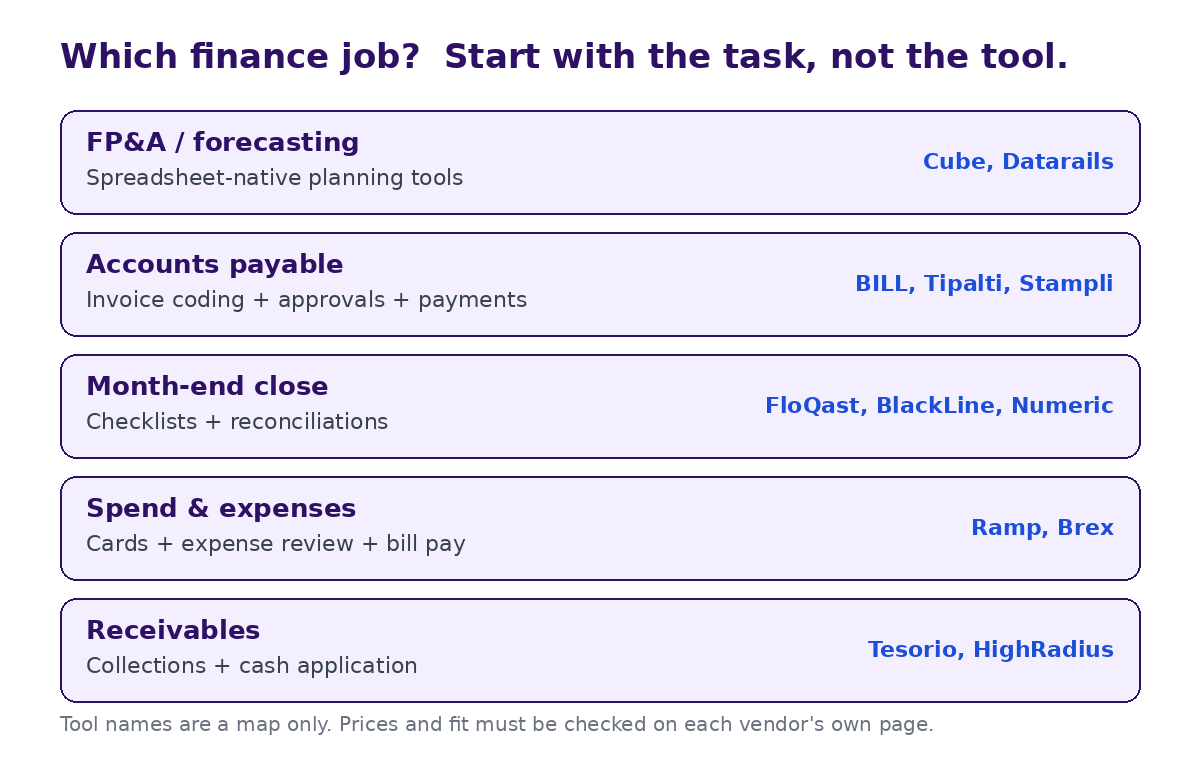
Planning and forecasting (FP&A). This is the spreadsheet-native corner of the market. Cube and Datarails both keep finance teams working in spreadsheets — Cube across Excel and Google Sheets, Datarails as an Excel-native platform — while automating consolidation, reporting and planning around those models. The distinction that matters for a story is not which one is “better” but which workflow the team already lives in, and what happens to the model when the person who built it leaves. Both are quote-based; neither publishes a fixed price on its current pricing pages, so any article that prints a monthly figure for either one is publishing history, not a current price.
Accounts payable. BILL, Tipalti and Stampli all automate the same painful loop: an invoice arrives, someone codes it, someone approves it, someone pays it. BILL is the most transparent of the three on price, and that transparency is itself part of why it appears in so many lists. Its pricing page, checked on 4 November 2026, lists Essentials at $49, Team at $65 and Corporate at $89 per user per month, with Enterprise on custom pricing, and a separate Spend & Expense plan at $0 per user per month. The detail that separates a careful article from a copied one is the plan boundary: AI multi-line bill coding with the BILL Invoice Coding Agent is included from the Team plan, not on Essentials, and automatic two-way sync with QuickBooks Online and Xero starts at Team, while the deeper ERP syncs — NetSuite, Sage Intacct, Microsoft Dynamics and others — sit in the custom-priced Enterprise plan. Transaction fees sit on top of the subscription: $0.59 per ACH or ePayment, $1.99 for a mailed check, free for a virtual card, and $19.99 for an international USD wire, all as listed on the same page. A team that only reads the headline seat price will underestimate its bill. A pitch that says so, with the page cited, is useful to an editor in a way a ranked list is not.
Month-end close and reconciliation. FloQast, BlackLine and Numeric own this job. FloQast’s approach is built around the close checklist and reconciliation work that stays close to Excel workpapers, with Reconciliation Management and AutoRec Matching automating the matching of bank, clearing, credit card and intercompany transactions, and a Reconciling Items feature tracking timing and unknown errors. BlackLine covers the same territory at enterprise scale, with record-to-report and invoice-to-cash scope. The editorial angle here is rarely the feature list. It is the control story: who prepares, who reviews, who signs off, and what audit trail the tool leaves behind. Close tools are quote-based, and the honest article says so and explains what drives the quote — entities, volume, modules, implementation scope — instead of inventing a figure.
Spend and expenses. Ramp and Brex combine corporate cards, expense review and bill pay, and both publish prices. Ramp’s own pages describe a free core tier and a Plus tier at $15 per user per month plus a platform fee based on team size, with Enterprise on custom pricing. That platform fee is the part most lists drop: Ramp does not publish a figure for it, so no total can be calculated from the seat price alone, and a careful article says that plainly. Brex’s own pages describe Essentials at $0 per user per month and Premium at $12 per user per month, with Enterprise on custom pricing. The useful comparison is not the $3 seat difference. It is eligibility, ERP fit, and which controls sit behind the paid tier — the questions a finance reader actually needs answered before a demo.
Receivables and collections. Tesorio and HighRadius sit on the revenue side: chasing payment, applying cash, and managing deductions. This is the task most “best AI tools” lists treat as an afterthought, which is exactly why it makes a strong pitch angle. A story about the one task nobody covers, told with a real example of a collections workflow, stands out in an inbox full of identical AP-and-FP&A lists. Both are quote-based; describe the workflow, not a price.
Why this topic is hard to get published on
Three habits make finance AI coverage hard to place, and all three are visible in the current search results. Naming them in your pitch — and showing you avoided them — is often what gets the reply.
First, vendor lists ranking their own tool first. At least two of the prominent results for this keyword are published by vendors whose own product sits at the top of their own list. Editors know this pattern. A pitch that repeats a vendor’s ranking as if it were independent research reads as a press release, and it will be treated as one. If your evidence comes from a vendor, say so, and say what you checked independently.
Second, conflicting prices presented as settled fact. The same tool carries different figures in different lists, sometimes because the figure is old, sometimes because it belongs to a different plan, sometimes because a platform fee or transaction fee was left out. The BILL figures above could be verified on BILL’s own pricing page on the draft day; the Cube figures circulating in older comparisons could not be verified on any current vendor page, so they do not appear in this article as current prices. That discipline — verified figure or no figure — is the difference between a pitch an editor can defend and one she cannot.
Third, accuracy and time-saving claims with no test behind them. Vendors report impressive numbers: accuracy rates, hours saved, faster processing. Those numbers come from vendor surveys, customer samples, or specific deployments, and they are routinely repeated in lists as if they were measured for every buyer. This article publishes none of them, because none could be independently verified for a general reader. A pitch that promises a percentage without a method will be read as marketing. A pitch that says “we measured this on our own invoice volume, here is how, here is what we found, here is where it did not work” will be read as a story.
The same by-task discipline applied to legal AI tools is described in the companion piece on AI tools for lawyers.
What editors look for: a checkable claim, a named task, a stated limit
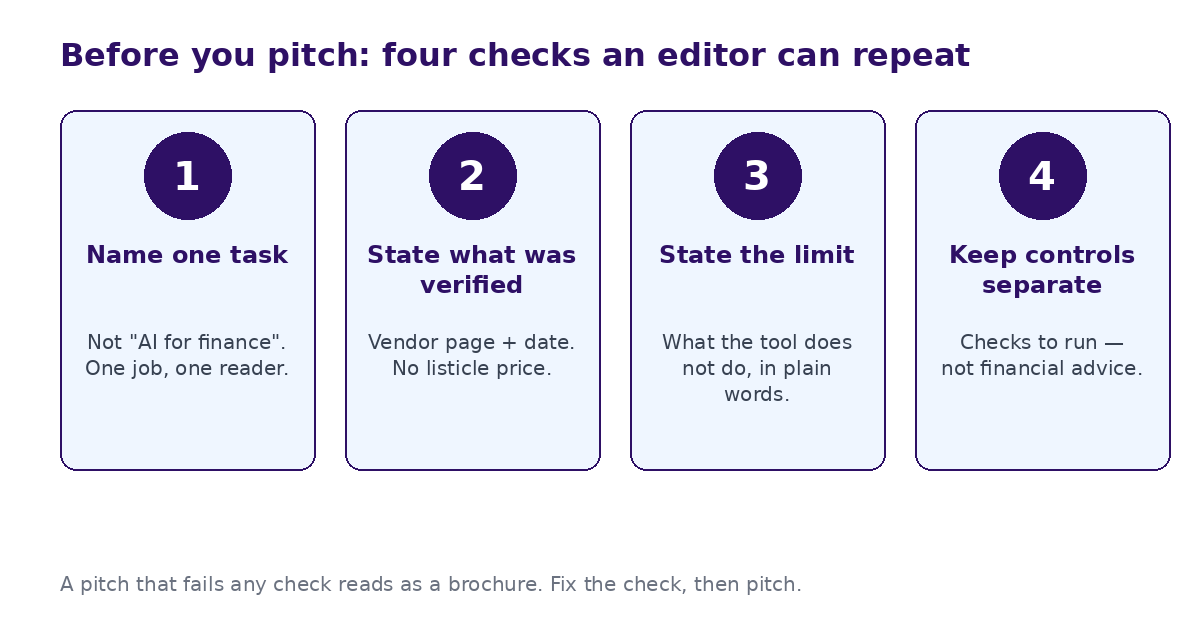
An editor deciding between two pitches on the same topic is really deciding which one she can stand behind. Four things tip that decision, and none of them is the size of the list.
A checkable claim beats a big claim. “BILL lists AI bill coding from the Team plan at $65 per user per month, checked on its pricing page on 4 November 2026” can be verified in a minute. “This tool cuts AP time in half” cannot, unless the pitch includes the method, the sample, and the baseline. Lead with the claim the editor can check.
A named task beats a named category. “AI for finance” is a category, not a story. “How a three-person finance team codes 400 supplier invoices a month without adding headcount” is a story, because the reader can picture the job and judge whether the method fits their own volume. The task map above is the starting point; the pitch should narrow it to one task and one reader.
A stated limit beats a perfect product. Every tool in this market has a boundary: a plan that unlocks the integration you need, a transaction fee that changes the economics, a workflow the AI suggests but a person must approve. Naming the limit in the pitch does not weaken it. It tells the editor the author has actually used or investigated the tool, and it gives the reader the one piece of information most lists leave out.
A reader the editor recognises beats a generic audience. “Finance teams” is everyone and no one. “Controllers at companies running NetSuite with two entities” is a reader an editor can picture, and a pitch written for that reader will read as if it belongs in her publication. Say who the story is for, in the first paragraph of the pitch, not the third.
How a finance vendor earns a placement
The placement itself is rarely the hard part. The hard part is having something worth placing. The strongest finance AI stories in this market share a shape, and it is worth building deliberately rather than hoping a listicle pitch lands.
Start with one real workflow, told in order. Pick the task from the map above that your product or your team actually does well, and describe it the way it happens on a Tuesday: where the document arrives, what the AI suggests, what the person checks, what happens when the suggestion is wrong. A workflow told in order is hard to fake and easy for a reader to test against their own process. It also gives the editor quotable detail, which is what she needs to justify the slot.
Then attach the verification. For a price, that means the vendor’s own pricing page and the date it was checked, with the plan boundaries and the fees on top. For a feature, it means the vendor’s own documentation or a named, observable behaviour — “the Invoice Coding Agent is listed from the Team plan” — not a competitor’s summary. For a result, it means your own measurement, with the sample size and the baseline stated, or no result claimed at all. Verification is not decoration. It is the article.
Then name the control. Finance is the one market where an AI suggestion that reaches the books unchecked is a genuine risk, not a hypothetical one. A credible story explains who reviews AI output before it posts, what audit trail exists, and what happens when the model is wrong. This is not financial advice and should never be framed as such; it is a description of a control the reader can discuss with their own controller or auditor. Editors in finance publications treat this section as the trust test. Skip it, and the rest of the pitch reads as promotion.
Finally, offer the editor something she cannot get from the vendor’s own blog: a comparison on stated criteria, a failure case, or a decision the team made and why. A vendor comparing itself to competitors on its own criteria is expected. A vendor explaining why it is the wrong choice for a particular team size or ERP is memorable, because it is rare. That honesty is what earns the backlink and the second placement, not the first pitch.
What to prepare before pitching a finance publication
Before a single email goes out, assemble a small pack. It takes an afternoon, and it changes the pitch from a request into an offer.
First, the topic in one sentence, naming the task and the reader: “How NetSuite controllers handle intercompany reconciliations during close, and where AI matching helps and where it does not.” If the sentence needs a comma and a second clause to make sense, the topic is still two topics. Split it.
Second, the verified facts, each with its source and check date: the pricing page figures, the plan boundaries, the feature as documented. Keep this list short. Three verified facts beat ten unverified ones, and the editor will check at least one.
Third, the example or workflow, told in order, with the limit included. If the example is a customer’s, have the permission in writing before the pitch. If it is your own team’s, say so. Never present a hypothetical example as a real one.
Fourth, the disclosure. If the article is sponsored, placed, or written by a vendor about its own product, say so in the pitch. Editors decide placement partly on disclosure, and discovering a commercial relationship after acceptance ends the relationship. A clean disclosure in the first email builds the trust that gets the second article accepted.
Fifth, the format the publication actually runs. Read three recent articles in the target publication and match their shape: length, headings, whether they run tables, whether they link out to vendor pages, how they handle author bios. A pitch that fits the publication’s shape gets read. A pitch that asks the editor to invent a new format for you does not.
Mistakes that get a pitch ignored
A copied “best overall” list is the fastest route to the archive folder. If the pitch could have been written by reading three other lists, the editor has already read those lists. Originality here does not mean a contrarian opinion. It means a specific task, a verified fact, and a limit — the three things lists omit.
An unverified price is the second mistake, and the most common in this market. Quote-based tools given invented monthly figures, platform fees dropped from the total, transaction fees never mentioned: each one tells the editor the author did not check. In finance, where the reader will act on the number, that is not a style issue. It is a credibility issue, and editors treat it as one.
A vendor accuracy claim stated as fact is the third. An accuracy rate or a time-saving figure without a method, a sample, or a date is a vendor’s claim, not a finding. Attribute it, caveat it, or leave it out. The pitch that leaves it out and offers its own measurement instead is the stronger pitch.
A pitch that hides the commercial relationship is the fourth, and the most damaging long-term. One undisclosed placement can close a publication permanently. Disclosure is not a penalty. It is the condition that makes the placement possible.
And a pitch with no reader in mind — “for finance teams” with no size, system, or task named — is the fifth. It asks the editor to do the targeting work the author should have done. Name the reader, name the task, and the editor can do her job, which is judging whether her readers need this story now.
FAQs
What is the best AI tool for a finance team?
There is no single best tool. The right tool depends on the bottleneck task: forecasting, accounts payable, close, spend, or receivables. Start from the task, check the fit with the accounting system you run, then compare the total cost shape — seat price, transaction fees, and any platform fee — before shortlisting.
Why do AI finance tool prices differ so much between lists?
Because most enterprise tools are quote-based and publish no price, so lists repeat old figures, third-party estimates, or figures from a different plan. The figures in this article that could be verified on the vendors’ own pages on 4 November 2026 are BILL ($49/$65/$89 per user per month), Ramp Plus ($15 per user per month plus an unquantified platform fee) and Brex Premium ($12 per user per month). Everything else should be treated as a quote to request in writing.
Do finance AI tools replace the controller or the accountant?
No, in the framing used by every credible vendor page checked for this article. The tools suggest, code, match and draft; a person reviews before anything reaches the books. The control — who reviews, and what audit trail exists — is part of the product decision, not an afterthought.
What should a pitch to a finance publication include?
One task, one reader, three or fewer verified facts with sources and dates, a workflow told in order with its limit stated, and a clean disclosure of any commercial relationship. That pack gives the editor something she can check and a reason to reply.
Can a small finance team use these tools, or are they enterprise-only?
Both exist. The published-price tools (BILL, Ramp, Brex) include free or low-entry tiers, while close and FP&A platforms are typically sold on custom quotes sized to entities and volume. Team size matters less than task fit and ERP fit; a small team with a heavy invoice volume may get more from an AP tool than from a close platform, and vice versa.
The next step
If you sell a finance tool, or you run a finance team with a story worth telling, the order of work is: pick the one task, verify the three facts, write the workflow with its limit, and then pitch one publication that runs that shape. That is a slower route than sending a ranked list to fifty editors. It is also the route that gets answered, because it gives the editor something she can check, a reader she recognises, and a story her readers cannot already find elsewhere.
When that pack is ready, a guest post placement and the link building around it follow naturally — the placement earns its links because the article earns its readers. And if the story is about getting found at all, the question of how finance buyers discover tools in the first place — directories, lists, and search — is covered in the companion piece on AI tool directories.

CEO & Founder at Meta LinkerSEO Strategist | Guest Posting Specialist | Digital Growth Consultant