
A pitch lands in an editor’s inbox with a confident headline: a custom CRM costs $X. The editor’s first question is not whether the number is interesting. It is whose number it is, for what scope, and when it was checked. A price without a scope is not a fact. It is a guess with a dollar sign in front of it, and on a cost topic — where readers will budget against the figure — that guess does real damage.
This article is written from that editor’s side of the desk. It shows why published CRM cost ranges disagree with each other by an order of magnitude, what a trustworthy cost claim has to carry with it, and how a CRM vendor earns coverage on a topic where every other pitch prints a single number and moves on. It is about coverage, not about choosing a CRM for your business — though, as with most cost topics, the discipline that makes a story publishable is close to the discipline that makes a budget defensible. Neither Meta Linker nor Z Growth Media builds CRMs or software, and nothing here should be read as a quote for development work.
The direct answer: there is no single cost — a publishable claim names a tier, a scope, and a source
A custom CRM is not one product. It is anything from a one-workflow pipeline that replaces a spreadsheet to a platform that runs billing, portals, and automation across departments. Those are different builds, with different hours, different teams, and different prices — and every honest source says so. So the publishable answer to “what does a custom CRM cost?” is never a number on its own. It is a tier for a stated scope, published by a named source, with a date on it.
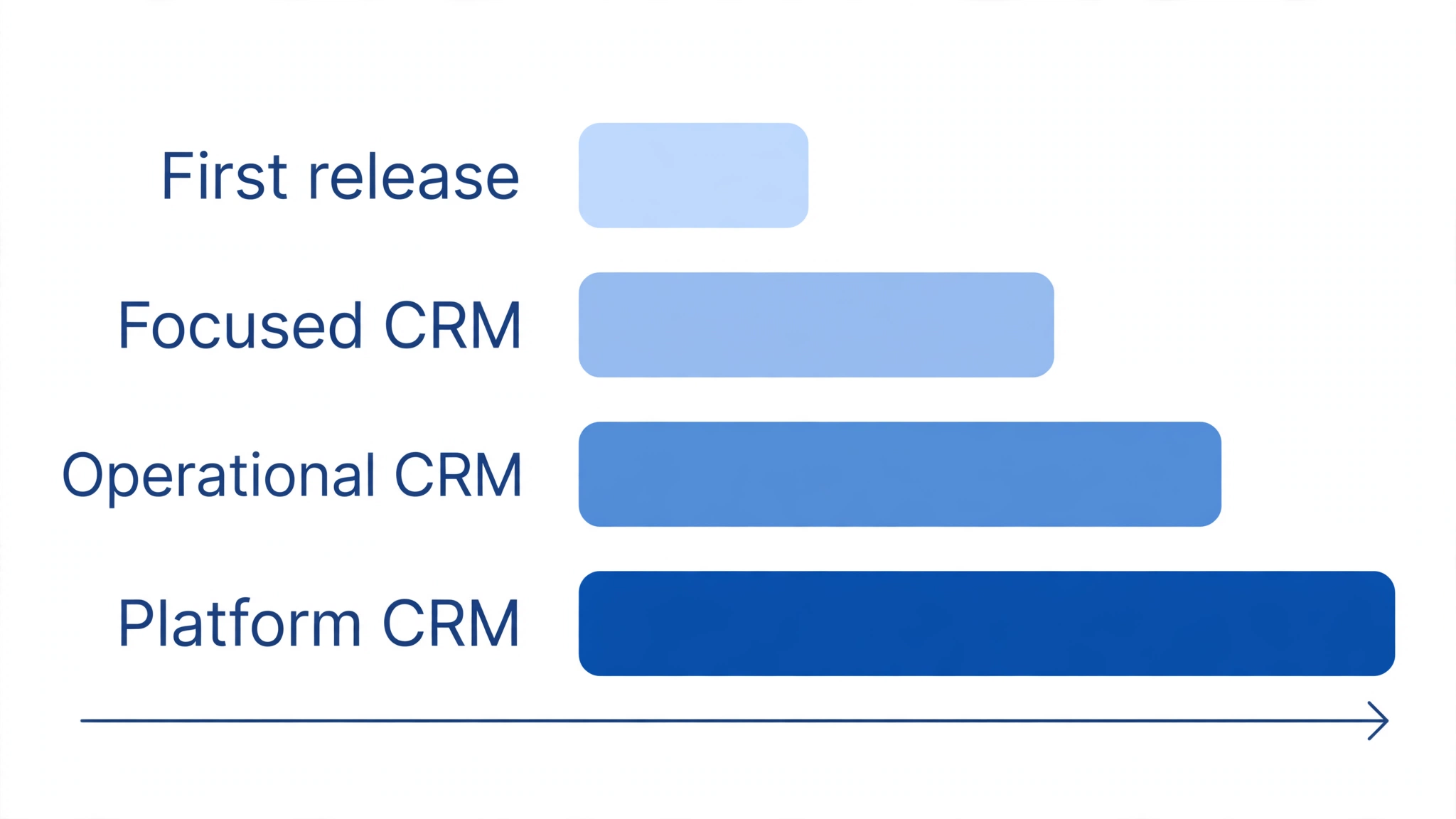
The most complete current breakdown, from development firm Rorixtech and checked live on 6 November 2026, puts it in three tiers: a focused CRM that replaces spreadsheets at $18,000 to $45,000 over 6 to 10 weeks; an operational CRM that runs daily work at $45,000 to $110,000 over 12 to 20 weeks; and a platform CRM that runs the business at $110,000 to $250,000 or more over 20 to 36 weeks. Those figures were published 4 September 2026 and updated 23 September 2026. They are one vendor’s planning bands, not a market survey — and that distinction is exactly what an editor wants to see stated, not hidden.
The ranges disagree — and that disagreement is the story
Lay the published ranges side by side and the first thing you notice is that they do not agree — and that is the most useful fact in this whole topic. A first release covering one workflow is $5,000 to $15,000 at Rocketech, taking 2 to 4 weeks, in a guide published 21 October 2026. A bounded MVP is $10,000 to $25,000 at Perimattic. A focused CRM is $18,000 to $45,000 at Rorixtech and $20,000 to $40,000 for a basic build at Merehead. A basic system is $30,000 to $60,000 at Purrweb. At the top end, Merehead stops at $150,000 and above, Rorixtech at $250,000 and above, and Netalith‘s high-rate enterprise band runs past $800,000.
| Source (checked 6 Nov 2026) | Entry point published | Top end published |
|---|---|---|
| Rocketech | $5,000–$15,000, first release, one workflow, 2–4 weeks | Priced per hour beyond that ($39–$55/hour) |
| Perimattic | $10,000–$25,000, MVP | $75,000–$200,000+, full suite |
| Rorixtech | $18,000–$45,000, focused CRM, 6–10 weeks | $110,000–$250,000+, platform CRM |
| Merehead | $20,000–$40,000, basic CRM, 2–3 months | $120,000–$150,000, enterprise |
| Purrweb | $30,000–$60,000, basic CRM | $100,000–$200,000+, enterprise |
| Netalith | $12,000–$41,000, lean build at low rates | $220,000–$810,000, enterprise at high rates |
These are all vendor-published planning bands, quoted as published, and they measure different things. A $5,000 first release and a $45,000 focused CRM are not two prices for the same job. One is a single workflow built to test an idea; the other is a working system for a team. A pitch that picks the lowest number from one vendor and the highest from another and calls the gap “the market range” has not found a range. It has found a misunderstanding.
Three things explain almost all of the disagreement. The first is hours. Netalith, which is unusually open about its method, puts a lean internal CRM at roughly 500 to 900 engineering hours, a mid-size build at 900 to 2,000, and an enterprise build at 2,000 to 4,500 or more — and states plainly that its bands are scoping assumptions, not a market survey. The second is the hourly rate, which runs from about $25 to $180 an hour across regions in Netalith’s bands, and from $25 to $55 in South and Southeast Asia up to $100 to $200 in the United States and Canada in Rorixtech’s regional table. Multiply a wide hour range by a wide rate range and the total spreads by a factor of ten before anyone has disagreed about anything. The third is scope: what counts as “a CRM” in the quote. A pipeline, a portal, billing, and AI scoring are not features on one list. They are different products sharing a name.
What editors check before they publish a cost claim
An editor who runs cost content has a short checklist, and a pitch that fails any item on it does not get published, however well written the rest is.
Attribution. Who published this figure, and where can the reader check it? A range with a named source and a link is a claim the reader can test. A range with no source is the author’s opinion dressed as data. Every figure in this article carries its source for exactly that reason.
Scope. What is inside the number? A focused CRM at Rorixtech covers contacts, companies, deals, tasks, notes, and follow-ups, with one or two user roles. A platform CRM adds billing, payments, automation, customer portals, external system sync, and audit logs. If the pitch cannot say which of those its number covers, the number means nothing.
Date. Cost content ages fast. The figures in this article were checked on 6 November 2026, and the Rorixtech guide they anchor on was updated 23 September 2026. A pitch citing a 2023 price list as current is not a pitch. It is an archive.
Method. How was the number produced — hours times rate, a tier table, a survey, or a guess? Netalith earns trust here by saying its figures are scoping assumptions, not a survey. A pitch that presents a planning band as a measured average is misrepresenting its own evidence.
What is left out. The build price is never the whole cost, and an editor knows the lines most quotes hide: data migration, which Rorixtech prices from $1,500 to $4,000 for one clean spreadsheet up to $12,000 to $25,000 or more for years of inconsistent records; support and iteration at 15% to 20% of the build cost per year; hosting at $50 to $600 a month; third-party services at $50 to $500 a month; and, where AI scoring is in scope, model usage fees of $200 to $3,000 a month. A cost article that never mentions migration or maintenance has described the down payment and called it the price.
The anatomy of a quote an editor can trust
Before a vendor pitches a cost story, its own quotes should survive the same scrutiny. A trustworthy proposal itemizes each of these, in writing: discovery and process mapping as a named phase with a deliverable, not absorbed silently into development; a feature list with exclusions — what is out of scope matters as much as what is in; each integration priced individually, because “integrations” as one word hides the real work; data migration quoted after someone has actually looked at the existing records; QA and user acceptance testing as a separate line, because testing folded into development is testing that gets compressed; deployment and handover, including environments, documentation, and training; first-year support and hosting as a recurring figure; and confirmation of who owns the code, the data, and the intellectual property.
A vendor whose proposals already look like that has the raw material for a publishable story. A vendor whose quotes are one line — “CRM development: $40,000” — does not, and no amount of outreach will fix it. The pitch is only as checkable as the quote behind it.
How a CRM vendor earns a placement on a cost topic
The strongest cost stories share a shape, and it is worth building deliberately. Start with one real workflow, told in order: where a lead arrives, who touches it, where the record moves, and where it currently breaks. A workflow told in order is hard to fake and easy for a reader to test against their own process — and it is also what lets a vendor scope honestly, because the process description exposes the approvals and handoffs a feature list hides.
Then attach the cost to that workflow, not to the word “CRM”. Name the tier, name the source of the range, and name what is outside it. A sentence like “a focused CRM in this shape runs $18,000 to $45,000 on Rorixtech’s 2026 bands, before migration and first-year support” gives the editor something she can verify and the reader something he can budget against. A sentence like “a custom CRM costs $30,000” gives neither of them anything.
Then offer the editor something she cannot get from the vendor’s own blog: a limit, a failure case, or a decision the team made and why. A vendor explaining why it told a ten-person team to buy a subscription instead of building — because below roughly ten users the per-seat spend has not compounded enough to justify a build, a point Rorixtech makes in its own guide — is memorable precisely because it is rare. That honesty is what earns the backlink and the second placement. The same discipline of matching a tool to one task before comparing options is set out in the companion piece on AI tools for finance teams.
What to prepare before pitching a cost publication
Before a single email goes out, assemble a small pack. First, the topic in one sentence, naming the workflow and the reader: “What a 20-person services firm should budget for a CRM that handles quoting and scheduling, and the three lines its first quote will probably leave out.” If the sentence needs a second clause to make sense, the topic is still two topics. Split it.
Second, the verified facts, each with its source and check date: the tier bands, the migration range, the maintenance percentage, the subscription prices used in any comparison. Keep this list short. Three verified facts beat ten unverified ones, and the editor will check at least one.
Third, the worked example, with its limit included. If the example is a customer’s, have the permission in writing before the pitch. If it is your own team’s, say so. Never present a hypothetical example as a real one, and never present a planning band as a price your company charged.
Fourth, the disclosure. If the article is sponsored, placed, or written by a vendor about its own product, say so in the pitch. Editors decide placement partly on disclosure, and discovering a commercial relationship after acceptance ends the relationship. A clean disclosure in the first email builds the trust that gets the second article accepted.
Fifth, the format the publication actually runs. Read three recent articles in the target publication and match their shape: length, headings, whether they run tables, whether they link out to vendor pricing pages, how they handle author bios. A pitch that fits the publication’s shape gets read. A pitch that asks the editor to invent a new format for you does not.
Mistakes that get a pitch ignored
A single number presented as the market price is the fastest route to the archive folder. It tells the editor the author did not read the sources, because the sources disagree with each other and say so. Lead with the disagreement and the reason for it, and the pitch reads as reporting. Lead with one number and it reads as marketing.
A copied tier table is the second mistake. Rorixtech’s tiers are good material, but a pitch that reproduces them without adding anything — no second source, no worked example, no limit — gives the editor a page she could have linked to directly. Originality here means a specific workflow, a second source that disagrees, and a stated limit.
Hidden ongoing costs are the third. A cost story that never mentions the 15% to 20% annual maintenance band, or the migration range, is not simplifying. It is understating the price by a fifth every year, and an editor who knows the field will notice.
A pitch with no disclosure is the fourth, and the most damaging long-term. One undisclosed placement can close a publication permanently. Disclosure is not a penalty. It is the condition that makes the placement possible.
And a pitch aimed at a generic reader — “businesses considering a CRM” — is the fifth. Name the team size, the workflow, and the system it must connect to. A 5-person team replacing spreadsheets and a 50-person firm with billing and a portal are not the same reader, and a pitch that treats them as one will satisfy neither.
FAQs
How much does a custom CRM cost?
There is no single cost. Vendor-published planning bands checked 6 November 2026 run from $5,000 to $15,000 for a one-workflow first release, $18,000 to $45,000 for a focused CRM, $45,000 to $110,000 for an operational CRM, and $110,000 to $250,000 or more for a platform CRM. The right band depends on scope, and every figure is a planning band from a named vendor, not a market average.
Why do published CRM cost ranges disagree so much?
Because cost is hours multiplied by an hourly rate, and both vary widely: roughly 500 to 4,500-plus hours depending on scope, and about $25 to $200 an hour depending on region and seniority. Vendors also mean different things by “a CRM” — a first release, a focused pipeline, or a full platform.
What does a custom CRM cost per year after launch?
Plan for 15% to 20% of the build cost per year in support and iteration, plus $50 to $600 a month for hosting, $50 to $500 a month for third-party services, and any AI model usage fees where scoring or summarisation is in scope. On a $70,000 build, Rorixtech puts support alone at roughly $11,000 to $14,000 a year.
Is a custom CRM cheaper than Salesforce or HubSpot?
It depends on team size and time horizon. For a team of around 20 users, Rorixtech’s own three-year comparison puts an off-the-shelf CRM at $78,000 to $126,000 against $94,000 to $100,000 for a custom operational CRM — the totals converge by year three, and the build cost then stays flat while the subscription rises at renewal. Below roughly ten users, a subscription almost always wins. List prices change often, so check the vendor’s current page before deciding.
How long does it take to build a custom CRM?
On Rorixtech’s published bands, a focused CRM ships in 6 to 10 weeks, an operational CRM in 12 to 20 weeks, and a platform CRM in 20 to 36 weeks, with integrations and data migration driving the schedule.
How much does CRM data migration cost?
It depends on the state of your records, not the size of the CRM: $1,500 to $4,000 for one clean spreadsheet, $4,000 to $9,000 for several spreadsheets with duplication, $6,000 to $18,000 for a legacy export with undocumented fields, and $12,000 to $25,000 or more for years of inconsistent records, on Rorixtech’s 2026 bands. It is the most common reason a build lands over budget.
What to do next
Build the pitch in this order: one workflow, one tier for a stated scope, one named source with a check date, the costs the quote leaves out, and the disclosure. If the story survives those five checks, it is worth pitching. If it does not, fix the story before pitching it — an editor will find the gap faster than a reader will, and a rejected pitch costs more than a delayed one.
If the bottleneck turns out to be visibility — the story exists, but the right editors and readers are not finding it — that is a different job, and it is the one Meta Linker does: guest post placement and link building that put a checkable story in front of the publication that should run it. The same discipline applies in both places. Say what you can verify, name the limit, and let the editor check.

CEO & Founder at Meta LinkerSEO Strategist | Guest Posting Specialist | Digital Growth Consultant